
For three nights and four days in early June, we called Mount Desert Island home. Just off the coast of Maine, “MDI” – as the locals call it – was the summer playground of wealthy Americans until the formation of Acadia National Park. Now, its hiking trails and carriage roads, its pristine ocean views, and its New England culture are open for all.
Acadia holds a special place in my heart, because it’s where Becca and I test-drove our new adventure, camping out in the woods for the first time and trying to start to define a new normal for the pace of life. As outlandish as it is, given that we’ve dedicated a year to it, the outdoor lifestyle is not really in my nature. I’ve loved the idea of the rugged, do-it-yourself simplicity of pitching a tent, gathering wood and water, and re-building your place to sleep, cook, eat, and live wherever you are. While I’ve read and reread Thoreau’s Walden and Pirsig’s Zen and the Art of Motorcycle Maintenance, these are skills I don’t have, and Acadia was where I began to learn them. Over the next year, I imagine that kindling and tinder, footprints and rainflies, coolers and propane cylinders, and headlamps and lanterns will become second nature for me. At Acadia, this life was all novel.
Here are the highlights of our too-short stint at Acadia. The national parks are too immense and detailed to see, do, and learn everything, even in a lifetime. So, here, I also document the things we missed, as a way to catalog plans for our next trips to Acadia.
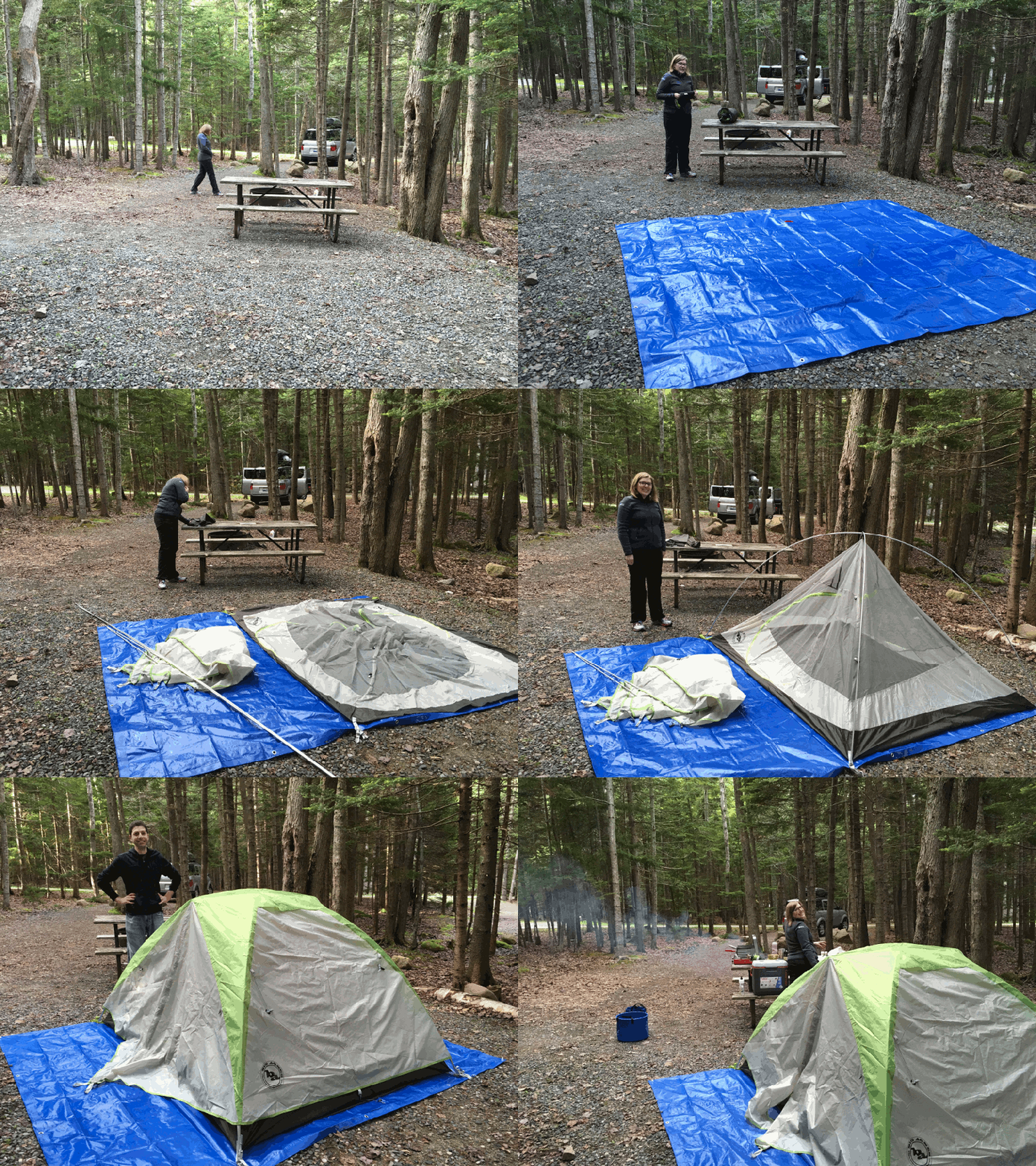
Camping out at Blackwoods
I learned that national park campgrounds are actually pretty darn civilized.
First, you can make your reservations online and pay with a credit card. Just like booking a hotel through Expedia or Priceline, you compare locations, amenities, and price. We selected Blackwoods at Acadia, which is the most popular and centrally located.
When you arrive, you check-in with a park ranger who goes over the basics: talking through the grounds map, where you’re staying, where there are bathrooms, water, and trash receptacles; where to find dry firewood, hot showers, and cold ice. For “car camping” (which we’re doing), you park in your designated driveway, set up your tent on the designated pad, make a fire in the designated ring, and sit and eat at the provided table. It’s all quite cookie cutter and well planned.
After a night, the campgrounds start to feel like home, with your bedroom as your tent, the kitchen by your propane stove and cooler, and your living room around the fire.
Hiking Rockefeller’s stone-stair trails
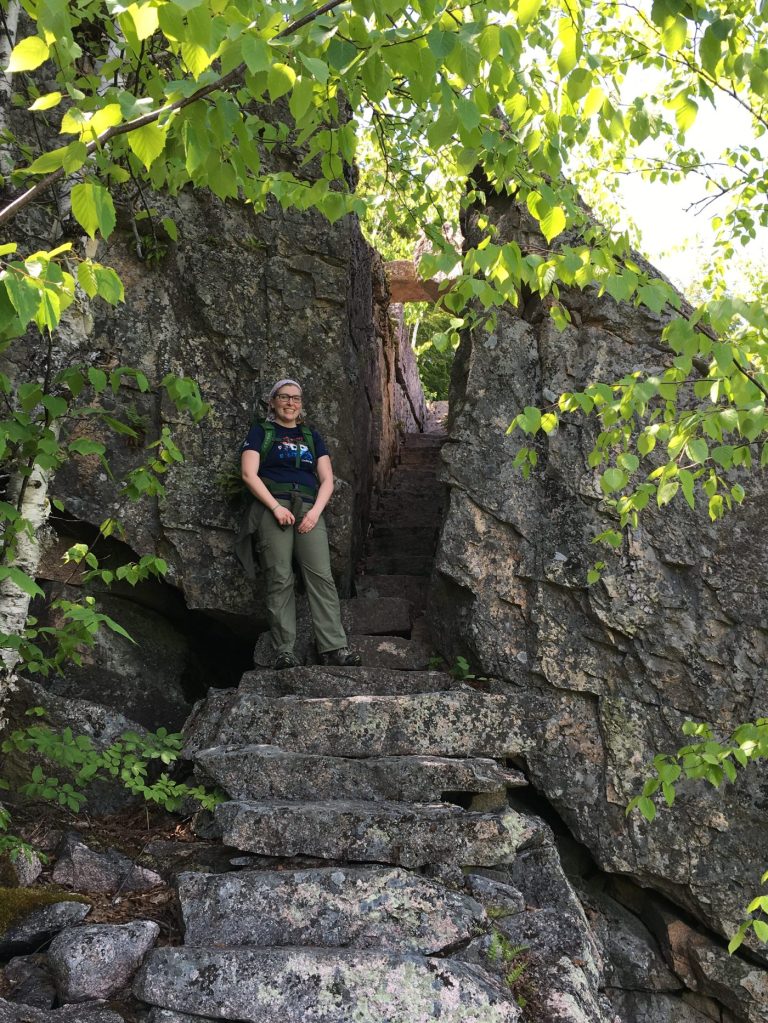
The Rockefeller family preserved much of MDI’s nature so that they could escape the big city, get away from noisy automobile traffic, and breathe fresh air. But they also built an infrastructure to make exploration fairly painless. The island is connected by carriage roads, initially meant for horses and free of cars, and today often journeyed by bicycle. They built hiking trails with stone steps and metal ladders and marked them with rock cairns. Becca and I hiked near The Tarn on Dorr Mountain, which has flight-after-flight-after-flight of large granite steps. It’s got great views of the ocean and the islands off the coast. This is a recommended introductory hike at Acadia.
A cruise to Little Cranberry
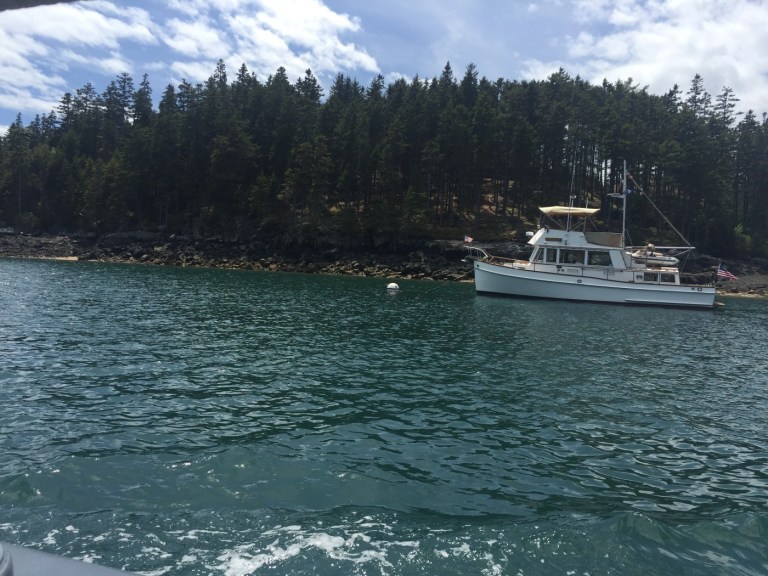
Acadia is about living off the ocean. And more importantly about lobster. We took a boat cruise, embarking from Northeast Harbor. On it, our guide talked about the landscape, the people, the history, and the fishing economy. The boat stopped at Little Cranberry Island, where some of the best lobster in the world are caught. My favorite story: Somes Sound, a body of water running through Mount Desert Island, was recognized as the only fjord on the East Coast. The designation was officially taken away because it’s not quite deep, dark, and cold enough at the bottom, so now it’s considered a “fjard” (a Swedish word for something similar-to-but-smaller-than a fjord). It turns out the so-called “dead zone” at the deepest part of the sound was not quite “dead” enough to the liking of the Scandinavians who make the fjord/fjard decisions. So the local residents took it upon themselves: they placed a granite plaque on the seafloor reading “Long live the Grateful Dead,” creating their own Grateful Dead Zone.
High tide at Thunder Hole
Along the rocky, eastern coast of the island, there’s a crowd favorite with waterpark appeal. But this natural feature lives up to the hype. There a deep hole in the rock face. Just before high tide, the waves creep high enough to begin to fill the hole with water. Each time the waves go back out to sea, air rushes in to fill the void. At just the right time of day, under just the right wave conditions, air pressure builds up in the hole and as water rushes in – BOOM! – it gets spit right back out with a striking force and a thundering roar, soaking everyone around. The night we were there, the tides were not perfect, so the hole gurgled and misted, but it never quite boomed.
Popovers at Jordan Pond
The civilized world of Acadia can be found at the Village Green in Bar Harbor, Maine, where you can sit back and read a book, or at the Jordan Pond House, a restaurant along the park’s Loop Road. There, we ordered popovers, Maine’s favorite pastry, and their own brew of blueberry tea. Because of rain earlier in the day, there was no outdoor seating the day we stopped in, but afternoon tea and pastries on the Jordan Pond House Green is just about the most New England thing you can do.


Taking in the view from Cadillac Mountain
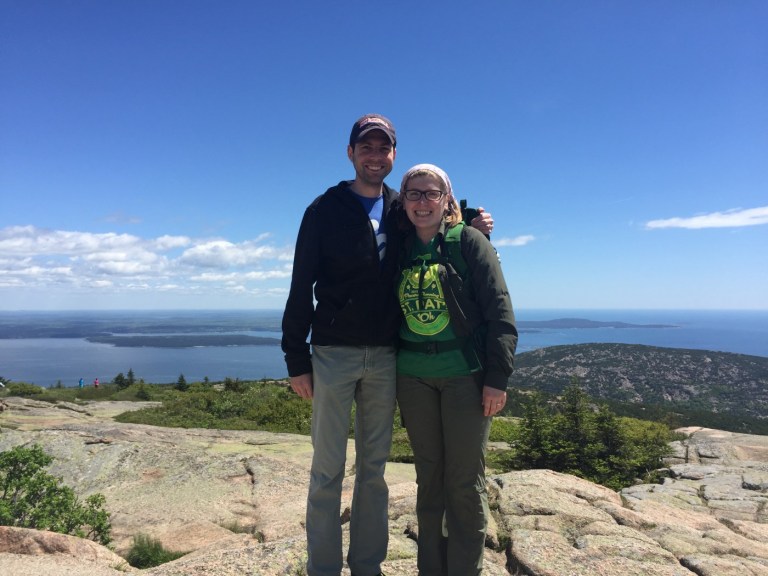
No visit to Acadia is complete without going to the top of Cadillac Mountain – by foot, by bus, or by car. Here, you get sweeping views out to sea all the way to Nova Scotia on a clear day and walk on the rugged stone faces that were scratched by glaciers thousands of years ago. Unfortunately, we didn’t get up there to see sunrise, the first place to see it in the United States (for part of the year, anyway).
Tips for next time at Acadia
If we went to the park later in the season, the free Island Explorer bus systems, supported by Maine’s L.L. Bean, means we can leave the Element at the camp and go on one-way hikes around the island. We could hike up Cadillac Mountain and take the bus down.
Next time, we’ll be sure to take the Beehive Trial, a strenuous hike with iron-rung ladders to climb steep rock faces on a mountain that resembles an inverted beehive.
It’d be nice to try a different campsite. We’ve heard that Seawall Campgrounds is in the “quiet” part of the island with a very different feel.
It’d be great to rent bikes from Bar Harbor and circle the island on the carriage roads.
Note: This post is specially made for Louis who’s planning a trip to Acadia in a few weeks and asked for our suggestions. I hope it’s helpful!
 out of our element
Thanks for the suggestions guys! Hope to see you when the temperature drops.
LikeLike
Definitely! Can’t wait to come visit!
LikeLike