
Adam and I have been fans of Frank Lloyd Wright for a while now (well his architecture, not endorsing his persona.) Our first Frank Lloyd Wright house visit was to Falling Water a number of years ago with friends. Since then we make it a point to visit his homes if we are somewhere nearby. When visiting Adam’s ‘rents, we took a day trip to Springfield, IL and saw the Dana Thomas House in Springfield, IL (Sidebar: in that trip we also visited Lincoln’s home, which was where Adam discovered the National Park passport, although we did not acquire the park passport until much later.) Adam also visited Wright’s Oak Park home with his ‘rents when they were visiting Chicago, but I missed out on that one.
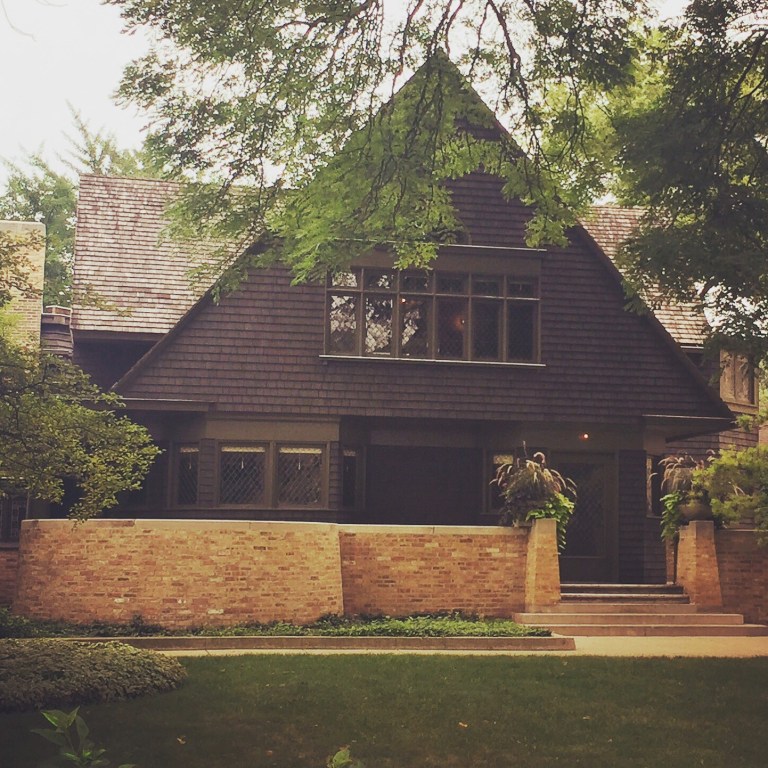
Given that we were in Indiana Dunes, just an hour outside of Chicago, Adam humored me and visited Wright’s Oak Park home and studio again. A guide walked a group of us through Wright’s home, which has been restored to how it looked around 1910, when Wright lived in it with his family. The docent mentioned that Wright claimed to have five (and only five) influences – Sullivan (the architect under whom he had an apprenticeship), Froebel Blocks, nature, music, and Japanese art. His Oak Park home exhibits all of these influences, from the geometric shapes he works into the design of the house and windows to the leaf shapes in some of the light fixtures. He built his kids the ultimate playroom- a large open room adorned with low windows so the outside was at a kid-sized height. The room included a large balcony that functioned as either a stage or seating for an audience, depending on where the kids wanted to perform. For Wright’s love of music there was a piano in the room, however, Wright couldn’t bear for the piano to take up so much space, so he cut a hole out of the room and suspended the legs of the piano over the stairway outside of the room. Wright seemed so persnickety in his attention to every subtle detail; I wonder if this trait inherently accompanies such creativity and out of the box thinking.
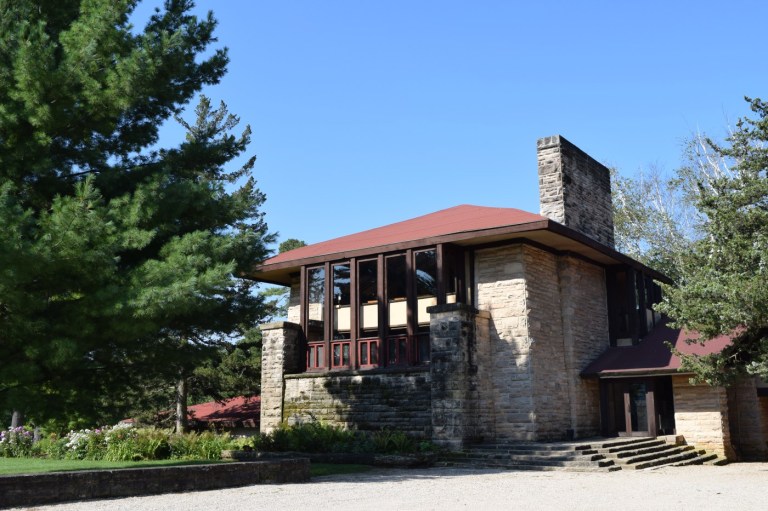
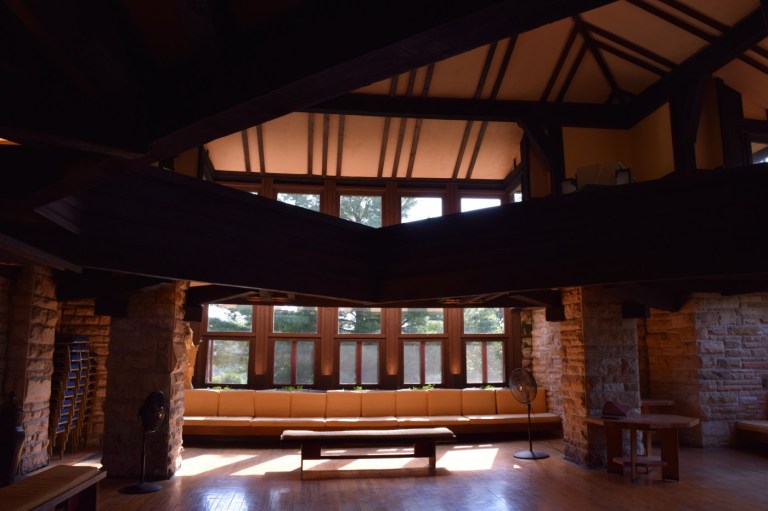
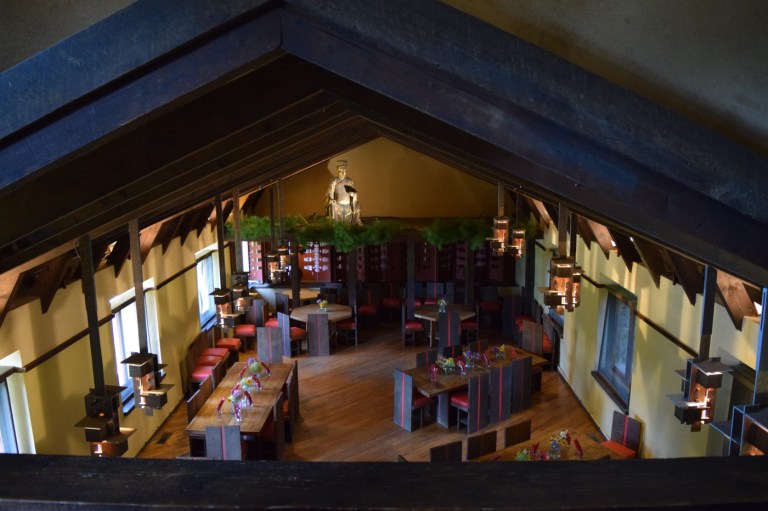
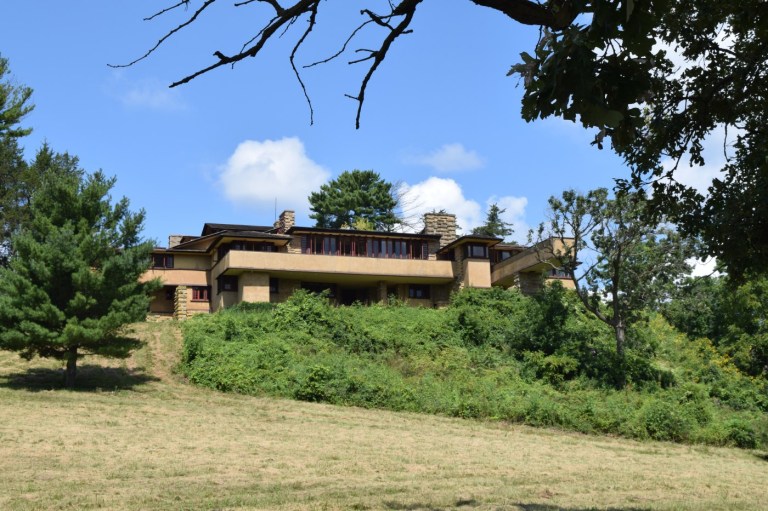
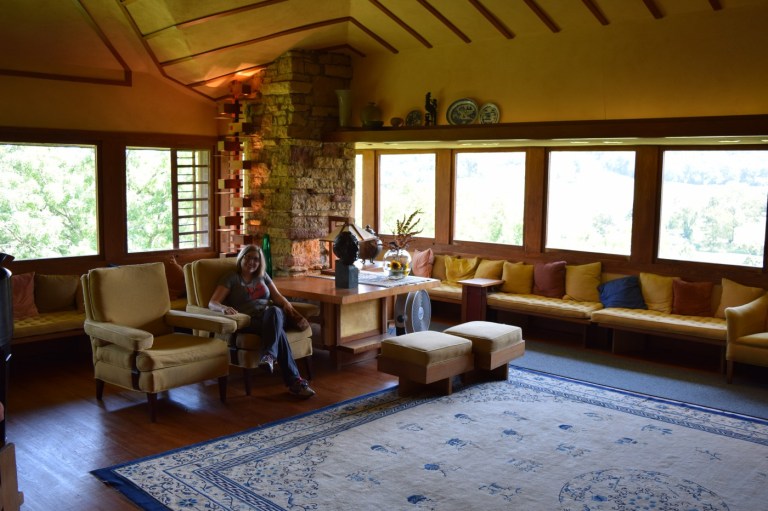
After Oak Park, we continued our Taliesin Tour into Wisconsin. We stayed at a hotel in West Madison for a few days- i.e., a place with reliably good WiFi so we could get some work done. Bright and early on a Tuesday morning, we drove about an hour to Wright’s Estate in Spring Green, WI, also known as Taliesin East. We reserved tickets for the Estate Tour – it is the longest tour option they offer (go big or go home, right?) that starts promptly at 9:30 am and includes 4 hours of walking through Wright’s home, studio and theater, and some neighboring buildings and structures. Wright spent his summers in Spring Valley, Wisconsin at Taliesin East and wintered at Taliesin West (in Scottsdale, Arizona). His students would maintain the same schedule, moving with Wright season to season. Perhaps the most intriguing part of the tour was knowing that these buildings were in constant flux. Wright viewed the school as a place of experimentation and innovation, a practice grounds of sorts for his students (or perhaps the more apt word is indentured servitude). Students learned their practice through building, modifying, and repairing the structures at Taliesin. Taliesin still functions as a school (one that Wright himself would likely not be admitted to if he were to apply today, given the prerequisites needed!) and also serves as a home for some retired architects who worked with or studied under Wright.
The buildings at Taliesin are in constant need of preservation and restoration- Wright built for the aesthetic and didn’t necessarily anticipate some of the wear and tear on his structures. For example, Wright incorporated nature into his architecture, often choosing to build around a tree that was in his way; as such, the structures need to be adapted to the tree’s continued growth. Foundation issues have crept up that led to the preservation team needing to stabilize parts of the home. A more recent issue structural issue resulted from some animals burrowing their home beneath Wright’s bedroom; this is an issue that still needs to be resolved. It is no wonder that the tours are not cheap, as there are always more construction projects than the preservation society has money to fund.
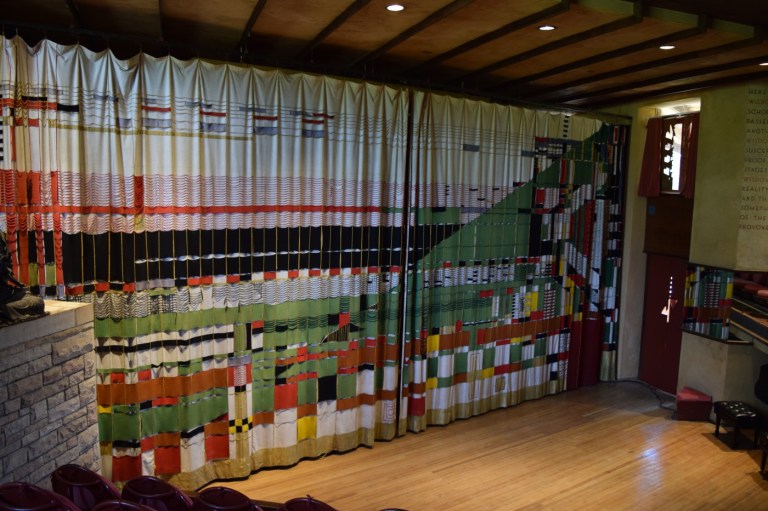
I could go on for a while but I’ll end my Taliesin tour commentary with my favorite Wright story that I’ve heard to date, which again illustrates again his persnickety nature. Wright constructed a theater in Taliesin East and had plans for a theater curtain that never got made, because the design was quite detailed and therefore time consuming to construct. His wife gave the plans to his students so they could make the curtain for him as a birthday gift. When they presented it to him, he commented that it needed some work- the white color was too white (it ended up obtaining its off-white color thanks to the help of Nescafe), among other things. It seemed that Wright’s students’ work was never done!
And now for some pictures:
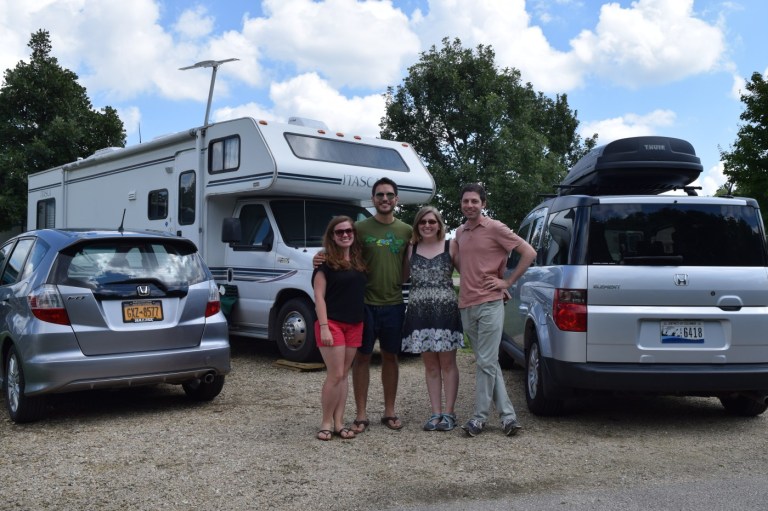
At the end of our stay in Madison, WI, we met up with Nothing Mundane (i.e., Heather and Jake). Interestingly enough, Heather and Jake went to Bucknell as well; they quit their jobs and embarked on a yearlong cross-country road trip almost a year before we did. Even though we didn’t know each other all that well, when I emailed Heather for some advice before we started our trip, she was more than happy to provide some tips. It just so happened that we were passing through the same city at the same time (we came from the east and they from the northwest), and we met up at a local park to show off our road tripping vehicles and then grab a bite to eat. We got lots of park recommendations from Heather and Jake, which just got me even more excited about all of the adventures yet to come this year. Great to meet up with you guys, and please, keep the recommendations coming 🙂 !
 out of our element